 Book a demo
Act III — The AI Question
There is much excitement about generative AI, and innovators are hunting left and right for the good applications of it. It is impressive, and every week seems to bring another installment of the science fiction we spent the last century dreaming about becoming reality. A good deal of that is hype, which makes the real thing harder to find rather than easier.
My excitement hasn't been found in just the general potential of generative AI so much as the unique potential role I see for the systems issues I've struggled with. For years I have been stuck on a problem in my own field with no way out from the inside. Building power takes people. Giving people real work takes the capacity to develop and support them. Building that capacity takes the time and resources you do not yet have. What results is a failure to scale beyond the usual roomful of people planning on post-it notes, the failure of our progressive causes, and the decline of democracy. This pattern has been a part of my work and a large part of my writing
Our political knowledge is centralized inside the heads of too few. The organizer's judgment. The strategy you rent from consultants. The unspoken norms of the organization that is lost when someone leaves their position. The working know-how of how a relationship can become a strategic asset. Scarce, expensive, and the reason the people closest to this work are often not equipped as they should be.
With this new technology knowledge is already starting to work differently. (Not really faster as some assume.) Before it took specific years of training to learn best practices in fundraising. Now a project can house the expert information and help build a plan with you in real time - combining best practices with community-level wisdom. Brand guidelines can automate copywriting. I think that this difference opens a systemic leverage point, not just about what we produce, but who has the power and ability to do it. And when it comes to organizing, I don’t think we’re talking enough about it.
You should be skeptical of generative AI. I am. The costs are real on a variety of levels. What does it do to democracy? The speed at which it accelerates power differentials that were already indefensible. Of course, the environmental destruction behind how many Big Tech AI companies operate. Privacy questions. It’s application in war. And quietly, from a cultural perspective, the unknowns about what it might do to our collective political imagination with LLMs using predictive people pleasing to decide what answers it shows you.
In relation to my points above, generic AI, pointed at this work and powered by market logic rather than intention, will do what the systems around us already do, faster. Replace people. Replace relationships. Make the transaction cheaper.
It does not have to go that way. This is not just a thesis. It's also what my team has been working on building.
The conversation is the product
by Ned Howey
As I mentioned in Chapter 16, my mother Ruth, had never used AI before. She had never made a digital poster. This is a woman who leaves a comment on every post she sees on Facebook, because the box says “Leave a comment”. (Her response when I ask her “Mom, why do you leave a comment on every post?”)
Here is what she would have typed, I imagine, if she had gone to ChatGPT instead of our tool.
Can you make a poster for our spaghetti dinner fundraiser on July 25 at 5pm at the Spaghetti Warehouse, $25 a plate, hosted by the Gay-Straight Alliance, call Ruth for tickets.
Et voila!
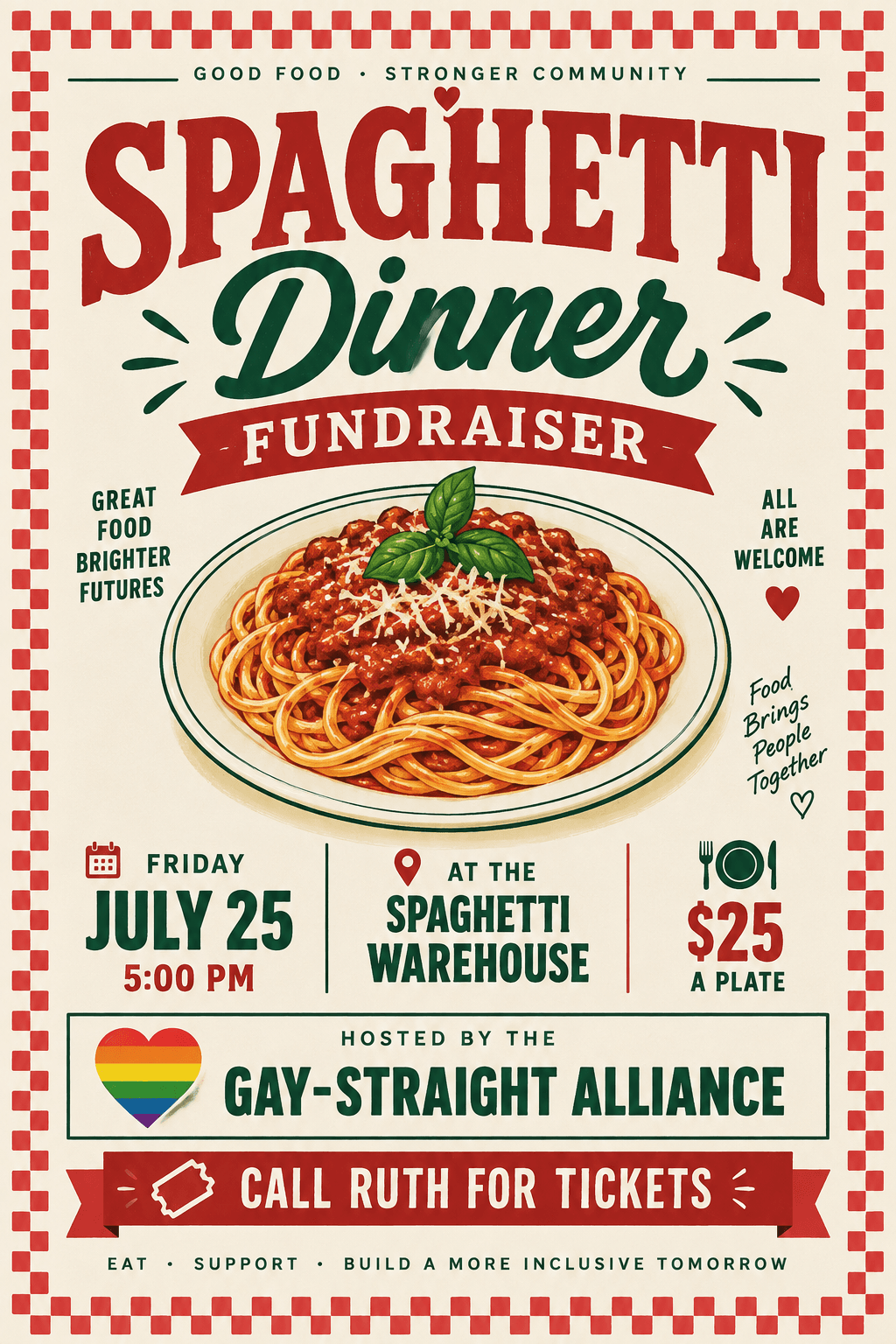
ChatGPT did not ask a single question. Not what size she needed. Not where it would hang or send. Not who was coming, or what she wanted them to do. It took the sentence and returned a poster. Nothing of her vision for the poster, her community, or intention.
Count the lines on it that nobody at the Gay-Straight Alliance had any part in. Good food, stronger community. Great food, brighter futures. All are welcome. Food brings people together. Eat, support, build a more inclusive tomorrow. Five pieces of messaging, invented by a machine and published in an organization's name.
The poster is not badly made. The type is legible and the layout holds, which is an improvement on earlier models. It is the thing I described in chapter five as slop, which is not bad work but generic work: the same composition, the same cheerful arrangement, the same border, whatever is being advertised and wherever it is going to hang. There is a cute checked tablecloth on it. There are no people in it. My mom had no part in the vision beyond her first prompt. It's sloptastic, spaghetti edition.
Our system asked her eleven fields' worth of questions and then wrote a creative brief, which is the document an agency produces before it starts work and part of what you are paying them for.
Here’s what my mom actually made:
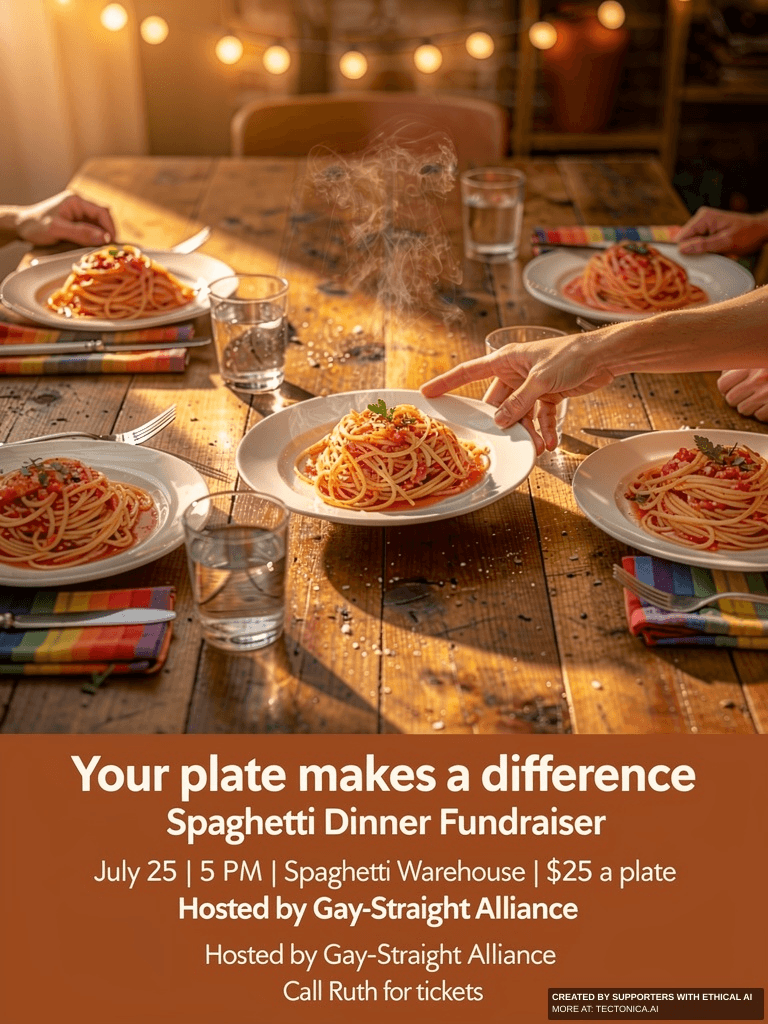
The difference is not the model.
Both prompts contain the same facts. The date, the time, the place, the price, the host, and Ruth.
What the second one contains is decisions. Some of them are hers, because it asked her for them. The setting. The feeling she wanted the evening to have. A style, chosen from a set she could look at.
The rest are the answers to those. A hand caught mid-pass rather than a table of just food. A three-quarter overhead angle, golden-hour light, a band of color across the bottom fifth of the frame reserved for words before there was an image to put them on.
She answered what she was asked. The design is what came back.
The brief is not more information. It is a set of decisions.
She was walked through every one of decision point and what came out was something reflective of the impact she wanted to make. (And can also have the brand guardrails of the organization baked in too, but that’s another point for another time.)
What the conversation is for:
Conversational design is an established discipline. Interface and voice designers have been doing it for years and they were our point of inspiration. What we changed is what the conversation is for.
Commercial conversational design assumes a service transaction. Somebody wants a thing, and the system's job is to hand it over with as little friction as possible. Ours assumes collective action, and political organizing as democratic practice. A service conversation is trying to find out what you want. This one is trying to get at what you know. Her vision for the evening. Who it was for. What this issue has cost the people who would be in that room. The thing about her town that is not true of anywhere else. All of it is what a predictive machine glosses over, because prediction returns the middle and none of that is anywhere near the middle.
It never once asked her how any of it should look. Three things sit underneath it.
The questions come from fourteen years of asking them. They are the questions we put to an organization in a room, in the order we put them, and asked with clarity. We know these questions create better work.
The Experience and Expertise Boundary. It’s true that the model decided the angle, the light, what the picture should show, and where the words would go. That is craft, it takes years, and my mom had no route to acquiring it. Our model did not decide that the evening was a spaghetti dinner, that the host was the Gay-Straight Alliance, that the price was twenty-five dollars, or that people should call Ruth. It asked her, and used what she said without substituting a guess. It knew how a poster works and it did not know her town.
The line sits somewhere different for every kind of work. There is no general rule for where a machine should stop, and finding it is most of the job.
Designed Friction. Some questions were declinable and some were not. The brief has eleven fields. Platform, size, campaign topic, image composition and rights are required, and nothing generates until they are answered. Audience, style, branding, focus, text, context and constraints are offered, and she could skip any of them. Skipping produces a warning rather than a block. The system tells her the result will be worse, and does what she asked.
Rights are required, and that is a values decision rather than a technical one. Audience is optional, which is the field you would expect organizing logic to insist on hardest. It does not insist. It warns her, because a process that cannot be declined is a toll rather than a design.
The brief is not a feature. It is what those three produce when they run at once.
Then it stops. Her words went on in layers she could drag where she wanted them, and edit again next week when the date moves. The organization's own QR code. Style selectors the commercial tools do not have. The machine did the part she could not do, and then it got out of the way.
None of this is about pictures.
The fundraising coach runs the same three principles across a different domain, so it asks different questions. It opens with three. Are you doing this alone or with a group? Do you know what tactic you want to run? Have you ever fundraised before?
That third one is not a question about the task. It is a question about her.
Then it asks the things a generic tool would never think to ask. Are you or anyone in your group personally affected by or connected to this issue? What is your relationship with the people you are planning to ask? Do you have a personal story connected to the cause, and if not, let us find one, because a story at the center of an ask is the strongest thing you have.
Behind those questions sits a whole field of practice. Peer-to-peer campaigns. House parties. Phone banking to people you already know. Crowdfunding, giving days, matching gifts, tribute pages, raffles. Bake sales, car washes, walk-a-thons, tournaments. If it’s your first time organizing you do not know that list exists, and have no way of telling which options suit a group of eleven people with six weeks to make an impact and the power of their personal network.
The Experience and Expertise Boundary sits somewhere else here. The system knows that first-timers usually arrive with the wrong idea in their heads, believing they are asking a favor for themselves rather than representing a cause they believe in, and it knows how to turn that around. It does not know who her people are, what they can give, or what this issue has cost them.
Designed Friction is calibrated differently too, because somebody working up the nerve to ask a neighbor for fifty dollars has a different tolerance for being slowed down than somebody choosing a color.
And out the other end comes a brief again. The goal, two or three recommended tactics with the reasoning attached, the audience, the personal story at the center of the ask, the steps, the language for the ask itself, and the guardrails. Then the plan, the call script, the email. The artifact is different. And yet, the shape is identical.
I have just published our design principles, and I’m aware that anybody can copy them. They are welcome to. The principles were never the difficult part. The difficult part is the fourteen years that produced the questions underneath them. It’s what built this and what will allow us to continue to iterate as technology evolves with us.
What we built is a process that runs as though an organizing strategist and a chief creative officer were sitting at the table with my mom.
That is not a figure of speech, it’s literal. Just like some AI prompts work better if you ask it to pretend to be a school teacher, our system runs on a persona. The persona is a senior creative strategist with a defined professional point of view, a domain it will defend, and rules about when to push back. It behaves the way a senior strategist behaves with a client: it holds the structure of the work, so that the only thing she has to carry into the room is what she already knows.
We wrote a value down about this before any of it was built. Amplify the voices, visions and solutions of diverse communities, rather than dull them with hegemonic datasets. That is easy to write. Put the two posters beside each other and you can see what it costs to mean it. One of them dulled her community into a checked tablecloth and five slogans about inclusion. The other one is her table.
She did not design that poster, and she did not need to. But every word is hers. The feeling is the one she asked for. The people at that table are her people, and while you cannot see their faces, it is more likely to resonate with her community. The reason for the evening is one she could explain to you herself, and the tool is built to transmit that visually.
The first poster could be for a spaghetti dinner in any town in America. The second could only be for the table she’s built.
The output is better because the thinking that produced it was better, not because the machine is better. Part of our job is to make sure the thinking still happens.
This is a reflection on how he got here, and why we need innovations built for people power. Ned Howey has spent fourteen years at Tectonica building organizing infrastructure for progressive movements.